Auberge Ostapé Review
One of the most beautiful rural luxury retreats in France, on a 45-hectare Basque estate with a Michelin-starred restaurant. Come for the setting, the silence, and the food, but arrive understanding that dining is limited to a single restaurant and activities are yours to organize.
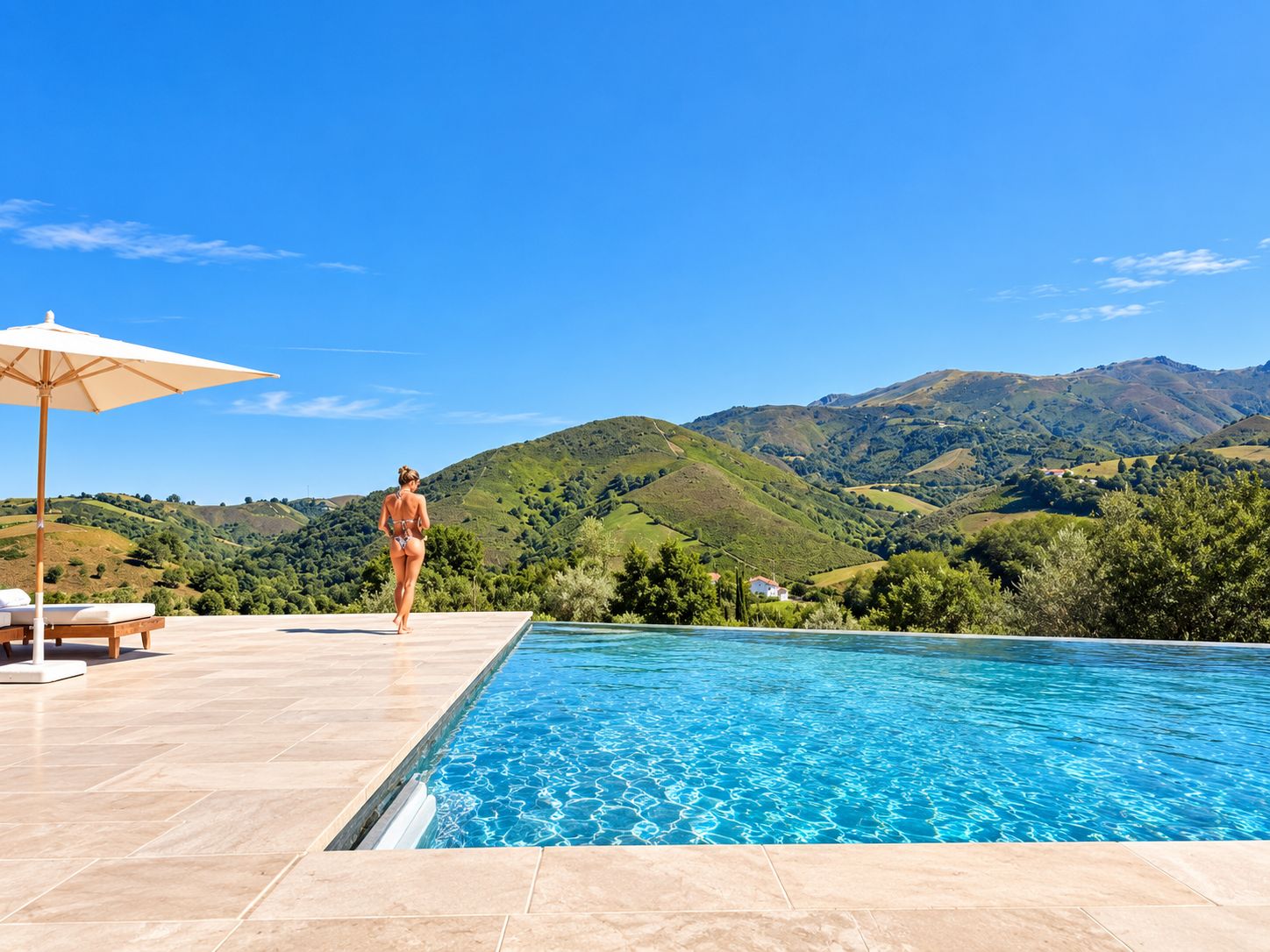
Overview: What is Auberge Ostapé?
Auberge Ostapé sits on a 45-hectare hillside estate above the village of Bidarray, deep in the French Basque hinterland roughly 30 to 40 minutes inland from Biarritz. The name means "in the shade of oak leaves" in Basque, and the property is built around a farmhouse dating to 1665. It was created in 2005 with the involvement of Alain Ducasse and today operates as a five-star member of Small Luxury Hotels of the World. The 26 rooms and suites are spread across five separate traditional red-tiled Basque houses dotted across the estate, most opening onto views of the surrounding forests, meadows, and the bluish silhouette of the Navarre mountains. Guests move around the grounds by electric golf cart. The property is intimate and quiet by design: there is a spa with a heated pool, sauna, hammam, jacuzzi, and gym, and a single restaurant, Lore Ttipia, which holds one Michelin star. Ostapé is a seasonal hotel, generally closed from early January to early March. It is best understood as a rural gastronomic retreat rather than a full-service resort, and two things define the guest experience in practice: the dining is concentrated in one restaurant with a set menu structure, and activities in the surrounding Basque Country are arranged by the guest rather than run as an organized on-site program.
Where is Auberge Ostapé? Location and access
The estate is at Domaine de Chahatoenia, on the heights above Bidarray in the Pyrénées-Atlantiques, in the Basse-Navarre part of the French Basque Country. Biarritz, its airport, and its train station are about 30 to 40 minutes away by car; Bayonne is about an hour. The hotel is genuinely remote, reached by narrow country roads, and a car is effectively essential for the stay: there is no walkable village center at the estate, and reaching restaurants, beaches, or trailheads means driving. The medieval pilgrimage town of Saint-Jean-Pied-de-Port, on the route to Santiago de Compostela, is a short drive south. The Spanish Basque border, San Sebastian, Pamplona, and the surfing beaches of the southern French coast are all within reach for day trips. The setting is the point: 45 hectares of preserved Basque nature, near-total silence, and panoramic mountain views. Travelers who want to walk out of the lobby into a lively town should look elsewhere; travelers who want to drive to a secluded estate and unplug will find few better bases in the region.
Nearby landmarks
- Bidarray village
- Saint-Jean-Pied-de-Port (Camino de Santiago pilgrimage town)
- Pas de Roland
- La Rhune mountain
- Biarritz and its beaches
- Bayonne
- Espelette (Basque pepper village)
- San Sebastian, Spain
- Pamplona, Spain
- Biarritz Pays Basque Airport
Rooms at Auberge Ostapé
The 26 rooms and suites are distributed across five separate traditional Basque houses, plus the 17th-century manor, rather than a single hotel block. Interiors pair warm, refined luxury with antique furniture, and many rooms have fireplaces, private terraces or balconies, and views over the forest or mountains. Standard comforts include air conditioning, minibar, safe, satellite TV, hair dryer, and free Wi-Fi. Because accommodation is dispersed across the estate, no two houses are identical, and the layout gives each cottage a private, secluded feel; electric golf carts ferry guests between their rooms and the main manor. The trade-off of the villa-scattered layout is that getting to the restaurant, spa, or reception means a short cart ride or walk rather than an elevator, which most guests consider part of the charm.
Service and staff
Warm, personal, small-property service is the consistent theme in guest accounts, with an attentive team that greets arrivals, assigns golf carts, and looks after guests across the estate. The reception team functions as the concierge: they will arrange transfers, book the restaurant, and help organize activities and excursions in the surrounding Basque Country. This is the important practical point for planning a stay. Ostapé does not run a resort-style, on-site daily activities program. There is no packed schedule of guided hikes, classes, or excursions laid on by the hotel. Hiking, cycling, horseback riding, canoeing, fishing, and trips to Basque villages, beaches, and the Spanish border are all available in the area, but it is up to the guest to decide what they want to do and to have reception book it, or to arrange it independently. Travelers who want everything organized for them should plan ahead and lean on reception before arrival; independent travelers will appreciate the freedom.
Amenities at Auberge Ostapé
The spa is the core wellness amenity: a heated swimming pool, sauna, hammam, jacuzzi, and a gym, with massage and treatment rooms. Cooking lessons have been offered on the estate. The 45-hectare grounds themselves are the main amenity, with forest, meadows, and walking terrain, plus electric golf carts for getting around. The estate also has event and meeting spaces (the restaurant seats up to 65, and the larger Les Ecuries and La Borde rooms handle events and weddings up to a few hundred), so the property doubles as a wedding and private-event venue in season. What Ostapé deliberately does not have is the breadth of a large resort: there is no kids club, no water park, no shopping arcade, and crucially no second or third dining outlet. The experience is concentrated and quiet rather than broad.
Full amenity list
- One-Michelin-star restaurant (Lore Ttipia)
- Heated outdoor swimming pool
- Spa with sauna, hammam, and jacuzzi
- Gym
- Massage and treatment rooms
- Cooking lessons
- Electric golf carts across the estate
- Panoramic restaurant terrace
- Free private parking
- Room service
- Event and wedding venues (Les Ecuries, La Borde)
- Free Wi-Fi
- Air conditioning
- Bike hire
Food and drink
This is the single most important thing to understand before booking. Ostapé has one restaurant, Lore Ttipia, set in the 17th-century manor with a panoramic terrace, and it holds one Michelin star under chef John Argaud, who trained with the Ibarboure brothers and at Le Meurice under Alain Ducasse in Paris. The cooking is excellent, built on Basque produce, with some ingredients finished over embers or on a hot stone. But the dining is limited in a way that matters for a multi-night stay. There is one kitchen and one menu structure: Monday to Wednesday the restaurant serves a bistronomic menu, and Thursday to Sunday it serves its gastronomic menu, and on those days the same gastronomic menu is offered at both lunch and dinner. In practice that means a guest staying several nights will see the same menu repeat, with no alternative restaurant on the estate to switch to. Reservations are required even for hotel guests, and the restaurant cannot accommodate walk-ins. Breakfast and room service are available. Travelers who want dining variety should plan to drive out for some meals (Saint-Jean-Pied-de-Port and other Basque villages have options), and everyone should book the restaurant in advance rather than assume a table.
Design and architecture
The estate is a study in Basque vernacular architecture: five red-tiled, white-and-timber traditional houses and a 1665 manor, scattered across rolling hillside so the buildings read as a hamlet rather than a hotel. Interiors lean into rustic-refined luxury, with antique furniture, fireplaces, exposed timber, and a restrained, warm palette that keeps the focus on the landscape framed through the windows. The design intent is immersion in the setting rather than statement architecture: nothing competes with the view of the Navarre mountains and the 45 hectares of forest and meadow. It is the antithesis of a slick contemporary design hotel, and that is the appeal. For travelers who find polished urban luxury sterile, Ostapé offers something older and quieter, rooted in a specific place.
Pros and cons
What stands out
- Extraordinary 45-hectare Basque-mountain estate setting with near-total silence and panoramic views
- One-Michelin-star restaurant (Lore Ttipia) under chef John Argaud, built on Basque produce
- Founded by Alain Ducasse in 2005; a member of Small Luxury Hotels of the World
- Intimate 26-room scale across five traditional Basque houses and a 1665 manor, so it never feels like a big hotel
- Warm, personal service from a small team who move guests around by electric golf cart
- Spa with heated pool, sauna, hammam, jacuzzi, and gym
- Excellent base for exploring the French and Spanish Basque Country, from Saint-Jean-Pied-de-Port to San Sebastian
What falls short
- Only one restaurant on the estate, and Thursday to Sunday the same gastronomic menu is served at both lunch and dinner, so dining repeats over a multi-night stay
- No resort-style activities program; hiking, cycling, riding, and excursions are available nearby but must be booked by the guest or arranged through reception
- Restaurant requires advance reservation and cannot take walk-ins, even for hotel guests
- Genuinely remote; a car is effectively essential and there is no walkable town at the estate
- Seasonal, generally closed from early January to early March
- Rooms are scattered across the estate, so reaching the restaurant or spa means a golf-cart ride or walk rather than an elevator
Fun facts about Auberge Ostapé
- The name Ostapé means "in the shade of oak leaves" in Basque.
- The estate is built around a Basque farmhouse dating to 1665, and the Michelin-starred restaurant occupies the 17th-century manor.
- Auberge Ostapé was created in 2005 with the involvement of chef Alain Ducasse.
- Guests get around the 45-hectare estate in electric golf carts assigned on arrival.
- The restaurant Lore Ttipia changes format midweek: a bistronomic menu Monday to Wednesday and a gastronomic menu Thursday to Sunday, the latter served at both lunch and dinner.
- Chef John Argaud trained with the Ibarboure brothers and at Le Meurice under Alain Ducasse in Paris before taking over the kitchen.
- The property is a member of Small Luxury Hotels of the World and sits about 30 to 40 minutes inland from Biarritz.
Is Auberge Ostapé worth it? The final verdict
A genuinely special rural retreat and one of the most beautiful places to stay in the French Basque Country, with a Michelin-starred kitchen and a setting few hotels anywhere can match. It earns its five stars on location, estate, service, and food. The honest caveats are not flaws so much as a matter of setting expectations correctly. Dining is limited to one restaurant, and Thursday to Sunday the same gastronomic menu runs at both lunch and dinner, so a multi-night stay means either repeating the menu or driving out for meals. And activities are self-directed: reception will help book them, but there is no resort-style program laid on, so guests should plan what they want to do. Come to Ostapé to slow down, eat well, and disconnect in extraordinary scenery. Do not come expecting the dining choice or organized activity schedule of a large resort. Understood on its own terms, it is exceptional.
Frequently asked questions about Auberge Ostapé
Is Auberge Ostapé worth it?
Yes for travelers who want a quiet, scenic rural luxury retreat with a Michelin-starred restaurant in the French Basque Country. It earns its five stars on setting, estate, service, and food. Two caveats to set expectations: dining is limited to the single restaurant, Lore Ttipia, and Thursday to Sunday the same gastronomic menu is served at both lunch and dinner, so a multi-night stay repeats the menu unless you drive out for meals. And there is no resort-style activities program, so hikes, cycling, and excursions are arranged by you or through reception. Come to disconnect and eat well, not for dining variety or a packed activity schedule.
Where is Auberge Ostapé located?
On a 45-hectare hillside estate above the village of Bidarray, in the French Basque hinterland (Pyrénées-Atlantiques), at 1135 Xahatoeneko bidea, Domaine de Chahatoenia, 64780 Bidarray. It is about 30 to 40 minutes by car inland from Biarritz, its airport, and its train station, and roughly an hour from Bayonne. The hotel is remote and a car is effectively essential.
How many rooms does Auberge Ostapé have?
26 rooms and suites, spread across five separate traditional Basque houses and a 1665 manor on the estate rather than in a single building. Many rooms have fireplaces, private terraces or balconies, and views of the forest or the Navarre mountains. Guests move between their houses and the main manor by electric golf cart.
What are the dining options at Auberge Ostapé?
There is one restaurant on the estate, Lore Ttipia, which holds one Michelin star under chef John Argaud. It serves a bistronomic menu Monday to Wednesday and a gastronomic menu Thursday to Sunday, with the same gastronomic menu offered at both lunch and dinner on those days. Because it is the only restaurant on site, a multi-night stay means the menu repeats unless you drive out to Basque villages such as Saint-Jean-Pied-de-Port for some meals. Reservations are required even for hotel guests; the restaurant does not take walk-ins. Breakfast and room service are available.
What activities are available at Auberge Ostapé?
The surrounding Basque Country offers hiking, cycling, horseback riding, canoeing, and fishing, along with day trips to Saint-Jean-Pied-de-Port, Espelette, Biarritz, and across the Spanish border to San Sebastian and Pamplona. Importantly, Ostapé does not run a resort-style, on-site activities program: it is up to the guest to decide what to do and to book it, either independently or through the reception team, who will help arrange excursions, transfers, and restaurant bookings. On the estate itself there is a spa with a heated pool, sauna, hammam, jacuzzi, and gym.
Who founded Auberge Ostapé?
The hotel was created in 2005 with the involvement of chef Alain Ducasse, on an estate built around a Basque farmhouse dating to 1665. The Michelin-starred restaurant is now led by chef John Argaud, who trained with the Ibarboure brothers in the Basque Country and at Le Meurice under Ducasse in Paris.
Is Auberge Ostapé open year-round?
No. Ostapé is a seasonal hotel and is generally closed from early January to early March. Opening dates vary by year, so confirm directly with the hotel when planning a late-winter or early-spring stay.
How do I contact Auberge Ostapé?
By phone at +33 5 59 37 91 91 or by email at contact@ostape.com. The website is ostape.com. The address is 1135 Xahatoeneko bidea, Domaine de Chahatoenia, 64780 Bidarray, France. Reservations for the restaurant should be made in advance, and reception can help arrange activities, transfers, and excursions.